This article reports Sean's own observation: PETG stored in the original Bambu AMS produced substantially less stringing for him than PETG left out in the open with his earlier workflow. It is not a controlled experiment, and it does not establish a universal cause.
The surprise was not that filament storage mattered. It was how visible the difference became in the prints. The important part is not jumping from one improved result to a sweeping conclusion. Stringing can have more than one cause, and different storage products do different jobs.
Can better filament storage reduce PETG stringing?
On my earlier setup, PETG sat out in the open. After moving to the AMS workflow, I stored it in the original AMS instead. I noticed far less stringing. The print result changed enough that storage stopped feeling like a background detail and became part of the printing workflow.
I would not say that the AMS solved PETG in general, that it repaired an already-wet spool, or that every difference came from a single variable. I changed the environment and workflow, not one isolated laboratory condition. The honest conclusion is narrower: better storage was a worthwhile variable to pay attention to in my prints.
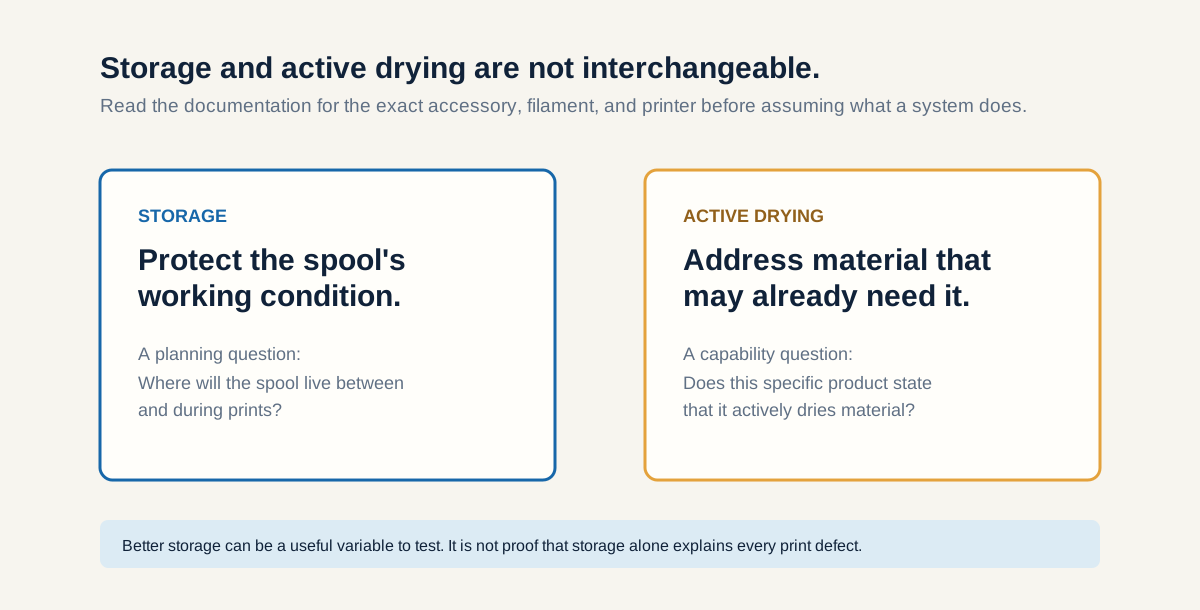
Storage and drying are related—but not the same job
Storage aims to keep a spool in a more controlled condition between and during prints. Active drying is a different function: it is intended to remove moisture from material that is already carrying it. Treating a sealed box, desiccant container, or material-management system as automatically equivalent to a dryer can lead to a bad diagnosis.
Product names can make this confusing. Before relying on any storage or drying claim, read the current documentation for the exact accessory, material, and printer generation. If the claim is important to your purchase, look for a specific stated function and compatibility rather than assuming that every enclosed system heats, vents, or dries.
Stringing is a clue, not a verdict
When strings appear between printed sections, it is tempting to blame the material immediately. That may be one possibility, but the more useful response is to keep a short troubleshooting ledger. Record the filament, how it was stored, the model, the print profile, the nozzle condition, recent changes, and what the strings actually looked like.
Then change one sensible variable at a time. If storage is your hypothesis, compare otherwise similar prints after a documented storage change. If the result improves, that is evidence for your own workflow—not a reason to declare every other explanation impossible.
A practical PETG troubleshooting order
- Confirm the exact material and the manufacturer's current handling guidance.
- Inspect the print for the specific defect rather than calling every surface flaw “stringing.”
- Note what changed since the last good print: spool, storage, profile, nozzle, model, or environment.
- Check the printer's documented maintenance and material-loading steps.
- Make one change, print a comparable small test, and keep the result with the settings.
- If a problem persists, seek help with the useful details: printer, material, profile, defect photos, and changes already tested.
Why this matters in a small space
Filament storage competes for the same limited shelf, desk, and closet space as everything else. A storage choice deserves the same fit-first questions as the printer: how much room does it occupy, how many spools does it really hold, where does it sit while printing, and does it simplify the routine enough to earn that footprint?
The answer may be a simple container and a tidy routine, an integrated workflow, or fewer spools bought more deliberately. The goal is not to accumulate accessories. It is to make the printer easier to use without making the room harder to live in.
Continue the framework
Fit the printer to the household first.
Use the home-fit guide and assessment before treating a printer feature or accessory as an automatic upgrade.
Read the home-fit guide →We do not currently use affiliate links in this article.To turn the same fit-first questions into a personal starting point, check your household and workflow priorities.